


At a glance
| Metric | Start (Dec 2025) | End (Mar 2026) | Change |
|---|---|---|---|
| Monthly organic clicks (Search Console) | 41 | 95 | +132% |
| Keywords on page 1 of Google | n/a | 12 | n/a |
| Domain Authority | 10 | 13 | +3 points |
| Inbound links | 395 | 481 | +86 (+21.8%) |
| Linking domains | 89 | 142 | +53 (+59.6%) |
| Linking domains gained in last 60 days | 1 | 29 | +28 |
| Linking domains lost in last 60 days | 9 | 0 | -9 |
Over the four months the site recorded 272 clicks and 32.4K impressions in total. Alongside the ranking gains, Thermapply Group’s content was cited inside Google AI Overviews for two commercial stadium safety queries.
Summary
Thermapply Group is a UK industrial safety and surfacing company. When we started, its two main product pages were competing in search with titles that were just product names, and almost no content was written to answer the questions buyers actually type into Google. In four months we rewrote title tags and meta descriptions, fixed technical SEO basics, published content built around Search Console gaps, restructured pages for answer engines (AEO), strengthened trust signals, and built niche backlinks. Monthly clicks rose from 41 to 95, 12 keywords reached page 1, and the brand earned citations in AI Overviews.
The numbers are modest in absolute terms, because this is a niche B2B industry with a low-volume search market. We think that makes the case more useful, not less: it shows what a focused programme can achieve on a low-authority domain (Domain Authority 10 at the start) without a large budget.
The client and the challenge
Thermapply Group sells engineered surface solutions to commercial and industrial buyers. Two products drove most of our work:
- Thermagrip: a patented thermoplastic anti-slip step profile system for high-footfall environments such as stadiums.
- CheckerSafe: anti-slip surfacing and floor markings for warehouses and industrial sites.
The starting position had four problems:
- Weak search snippets. Title tags on key pages were only the product name (for example, “THERMAGRIP” and “CHECKERSAFE”), and the meta descriptions were generic brand statements that did not mention the buyer’s problem or use case.
- Untapped demand. Search Console showed queries generating impressions but few clicks, meaning Google already associated the site with those topics but gave searchers no compelling reason to click.
- Low authority. Domain Authority was 10, with 395 inbound links from 89 linking domains, and a net loss of linking domains in the previous 60 days (1 gained, 9 lost).
- Thin trust signals. Buyers of safety products need evidence of real-world use, and the site offered little of it.
What we did
1. Rewrote title tags and meta descriptions around buyer intent
We replaced brand-only titles with titles that name the product category and the use case, followed by the brand.
| Page | Before | After |
|---|---|---|
| Thermagrip | THERMAGRIP | Anti-Slip Steps & Stadium Safety | THERMAGRIP |
| CheckerSafe | CHECKERSAFE | Warehouse & Industrial Floor Markings | CHECKERSAFE |
Meta descriptions were rewritten to lead with the benefit and the audience (for example, enhancing facility safety with durable, high-visibility floor markings) instead of repeating that the product is “premium” or “patented”.
A note for practitioners: Google rewrites snippets on some queries, so the description that appears for a given search can differ from the one in the page source. We treat the title tag as the more reliable lever.
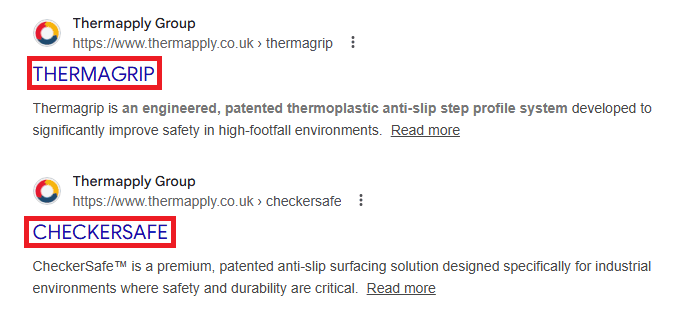
Before: brand-only titles and generic descriptions on the Thermagrip and CheckerSafe results.
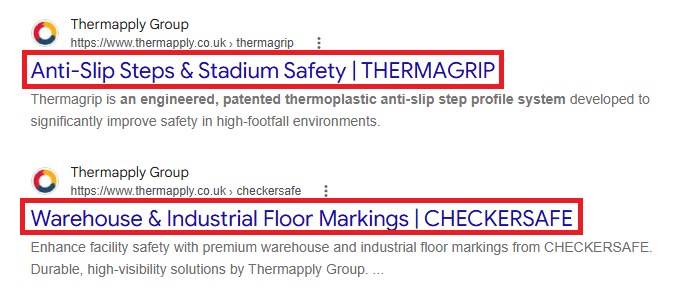
After: titles now state the category and use case before the brand name.
2. Fixed the technical foundations
We carried out page speed optimisation, added structured data (schema), reviewed robots directives and improved internal linking so that new content passed relevance to the money pages.
3. Built content from Search Console gaps, not keyword guesses
Instead of choosing topics from a keyword tool alone, we filtered Search Console for queries with high impressions and low clicks. Those queries are the clearest evidence of demand the site was already partly earning. For each cluster we wrote blog content targeting the main query and its related questions, then linked it to the relevant product page. Two of these articles, “How Can I Make UK Public Stadium Stairs Safer?” and “Why Slip-Resistant Stadium Flooring Is a Game Changer”, later appeared as sources in Google AI Overviews.
4. Structured content for Answer Engine Optimisation (AEO)
We changed how pages are written, not only what they cover:
- A short, plain definition or direct answer in the first lines of the page for the most frequently asked questions.
- Natural-language questions as H2 and H3 headings, matching how people phrase queries.
- One idea per section, so an AI system can lift a clean answer.
5. Strengthened E-E-A-T signals
We added customer testimonials and case studies to show first-hand experience on real projects, and made product pages more specific about compliance (such as DDA requirements) so claims were verifiable rather than promotional.
6. Built relevant off-page authority
Off-page work focused on niche directory listings and guest posts rather than volume. The aim was relevance to industrial safety, flooring and facilities audiences.
7. A strategic decision we disagreed on: national vs local
We recommended building location-specific landing pages to capture “near me” and regional searches. The client preferred a national strategy built on single landing pages, and we implemented it that way. This is a legitimate trade-off (simpler site, one page to maintain per product) but it caps how many local-intent queries the site can win. We cover this under next steps.
Results
Organic clicks and impressions
Monthly clicks in Search Console grew from 41 in December 2025 to 95 in March 2026, a 132% increase. Across the period the site earned 272 clicks from 32.4K impressions, an average click-through rate of 0.8%.
One detail is worth noticing. Impressions peaked in January at roughly 9.5K (read from the chart) and were 7,827 in March, around 18% lower, while clicks kept rising. March click-through rate works out at about 1.2% (95 clicks divided by 7,827 impressions), compared with roughly 0.7% in December (estimated from chart values). In other words, the site became more efficient at turning visibility into visits.
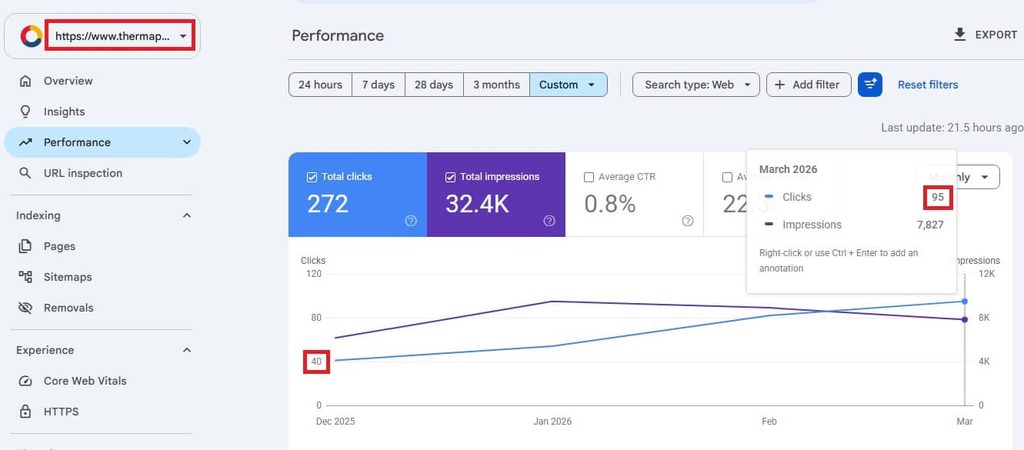
Google Search Console, Performance report (Web), December 2025 to March 2026.
Google rankings
The site reached page 1 of Google for 12 keywords. Two examples captured from UK search results:
- “anti-slip stadium steps”: the Thermagrip page holds the top organic result.
- “stadium anti-slip solutions”: two Thermapply Group listings appear in the top three results, one for the Thermagrip product page and one for the article on slip-resistant stadium flooring.
Please note that these rankings are effective March 2026 and subject to change.
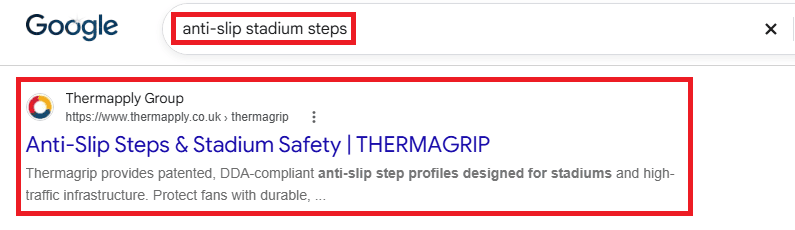
Search: “anti-slip stadium steps”.
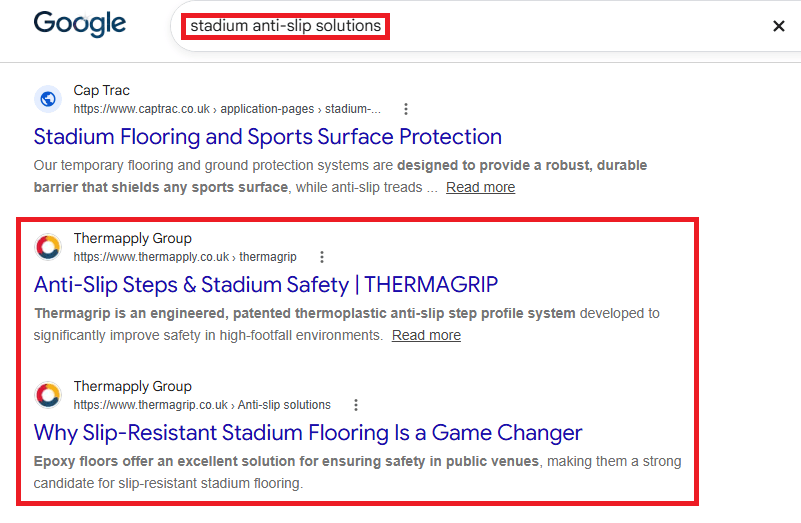
Search: “stadium anti-slip solutions”.
AI Overview visibility
By structuring content for AEO, Thermapply Group began appearing in Google AI Overviews:
- For “stadium anti-slip solutions”, the AI Overview cited Thermapply Group for its summary of stadium requirements, named Thermagrip by Thermapply as a recommended solution, and showed two Thermapply articles in the source panel.
- For “anti-slip stadium steps”, the AI Overview listed Thermagrip first among common solutions, referenced its DDA compliance and named stadium installations, and showed the Thermagrip page in the source cards alongside other suppliers.
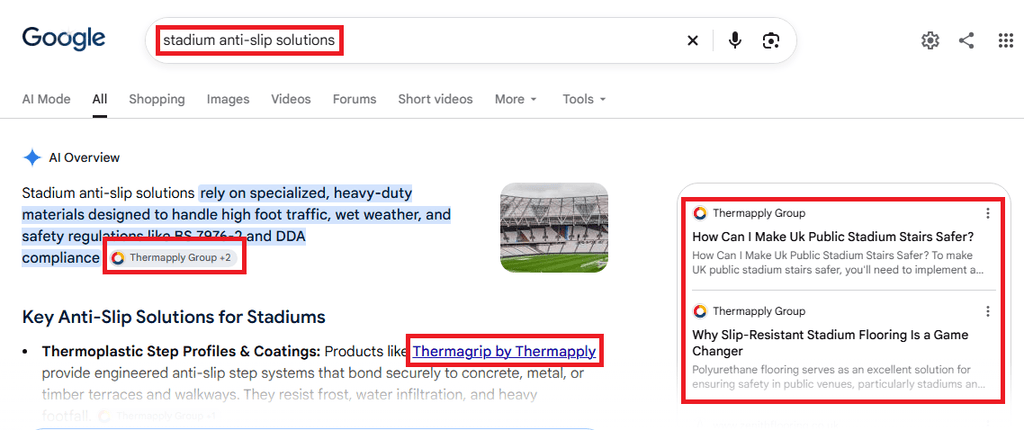
AI Overview for “stadium anti-slip solutions”.
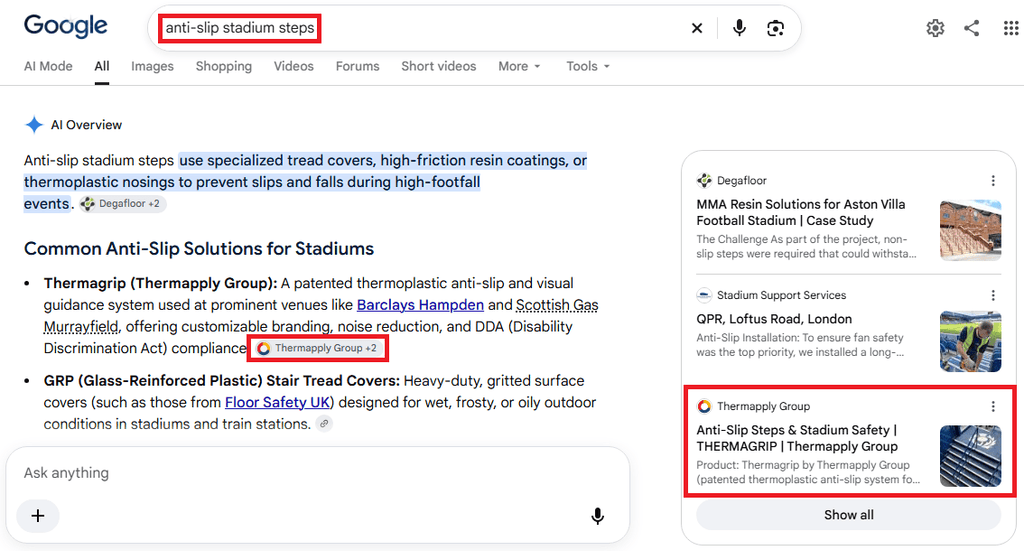
AI Overview for “anti-slip stadium steps”.
Authority and links
Domain Authority rose from 10 to 13, inbound links from 395 to 481 and linking domains from 89 to 142 (+59.6%). The 60-day link trend reversed: before, the site gained 1 linking domain and lost 9; afterwards it gained 29 and lost none. A healthy link profile is about stopping losses as much as adding links, and that reversal is arguably the most important off-page result. Domain Authority is a third-party metric and not a Google ranking factor, so we use it as a directional indicator only.
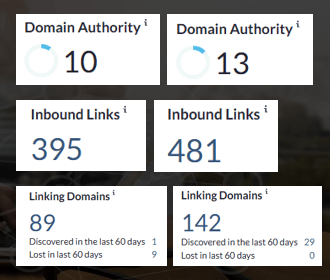
Link metrics before (left) and after (right) the campaign.
What this case suggests
These are our interpretations of the data, not proven causes.
- Brand-only titles waste the most valuable on-page real estate. Rewriting two titles to include the category and use case coincided with the click-through rate improving even as impressions fell.
- AI Overview citations were achievable at low authority. The site was cited at Domain Authority 13. Clear definitions, question-style headings and specific, verifiable product detail appeared to matter more than raw link authority.
- High-impression, low-click queries are a reliable content brief. They show where Google already trusts the site enough to show it.
- Link velocity matters as much as link count. Going from net negative to 29 new linking domains in 60 days is a stronger signal than the headline total.
Limitations
We want this case study to be useful and honest, so please read the results with these caveats:
- Small numbers. 95 clicks a month is a small base, and percentage growth looks larger on a small base.
- Short window. Four months is early. Rankings and AI Overview citations can fluctuate.
- Several changes at once. Titles, content, technical work, AEO and links were done in the same period, so we cannot isolate how much each contributed.
- Screenshots reflect a moment in time. Rankings and AI Overviews vary by location, personalisation and date. Ours were captured in UK search on [capture date].
- Impressions are not yet growing. They fell from their January peak, and average click-through rate across the period was still only 0.8%.
Next steps
- Revisit location pages for the highest-value regions, given the client’s national-only approach limits local-intent coverage.
- Expand the content clusters to the CheckerSafe and warehouse side, where we have less ranking evidence than for stadium steps.
- Monitor the quality of directory links and prioritise industry-relevant publications over general directories.
- Keep adding real project evidence (named installations, photos, measured outcomes) to strengthen first-hand experience signals.
Methodology and data sources
- Clicks and impressions: Google Search Console, Performance report, Search type Web, monthly view, December 2025 to March 2026. March 2026 figures (95 clicks, 7,827 impressions) are exact; other monthly values for impressions are read from the chart.
- Keyword rankings and AI Overviews: manual Google UK searches, with screenshots.
- Authority and links: third-party backlink tool (Domain Authority, inbound links, linking domains), compared before and after the campaign.
- Calculations: percentage changes computed from the figures above.

Внимание, если авто [url=https://mailsco.online/]mailsco.online[/url] новости. Это важно для выбора.
Your comment is awaiting moderation.