


This is a summary of a technical issue related to redirection we faced while doing SEO for a London based energy company.
The company had engaged a freelance web developer to redesign the website 2 months before we started the SEO work on this website. As part of the redesign process, the developer had redirected a few vital pages to new urls.
One of these new urls was a training portal which faced a very unique issue.
Users visiting the training portal experienced a split-second visual “flash” of a 404 Not Found error before the destination page successfully loaded.
An in-depth technical audit revealed that while BuiltWith detected a general WordPress environment, specific sub-routes (such as /training) functioned as a Single Page Application (SPA) or modern JavaScript bundle architecture hosted behind Amazon CloudFront / Nginx. Because the underlying server lacked a direct routing map for sub-folders, it threw an initial hard 404 status code before the client-side router caught the error and rendered the layout.
This case study outlines the diagnostic breakdown, the SEO ramifications, and the exact architectural fix implemented to resolve the issue.
The Challenge
- The UX Glitch: Upon navigating to /training, the browser network inspector logged an initial 404 document response code, accompanied by a ~375ms delay before JavaScript application chunks (chunk-XBGMN6QU.js, main-5FX4CCA5.js) mounted and displayed the content.
- SEO Vulnerability: Search engine crawlers (such as Googlebot) interpret HTTP status codes strictly. An initial 404 Not Found signal can cause search engines to de-index pages or flag them as “Soft 404s,” directly threatening organic search visibility and wasting crawl budget.
- Architectural Disconnect: A mismatch between server-side routing rules and client-side framework management caused the server to reject direct URL requests before passing control to the frontend framework.
Technical Diagnostics & Discovery
Using browser developer tools with cache disabled, the network request sequence confirmed the failure pattern:
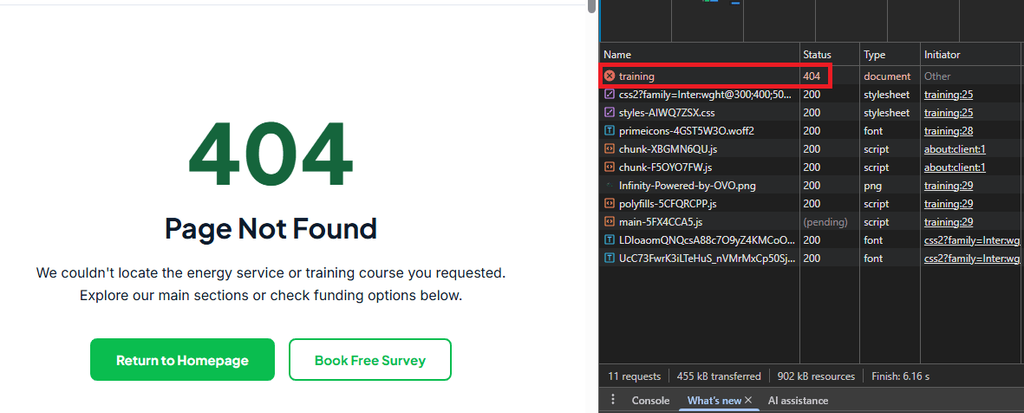
Plaintext
Request URL: /training
Initial Response Status: 404 Not Found (Document)
Subsequent Execution: JS Chunks & Stylesheets Loaded (200 OK)
Root Cause
The hosting infrastructure (AWS S3/CloudFront combined with an Nginx/Plesk layer) treated /training as a physical file path rather than a dynamic route. Because no physical directory or file named training existed on the server root, the server correctly threw a 404. However, a client-side routing script was intercepting the failure downstream to render the application view anyway—creating the dreaded half-second error flash.
The Solution
To permanently eliminate the 404 flash and safeguard technical SEO performance, the infrastructure required a shift toward proper SPA Fallback / Catch-All Routing.
Step 1: Configuring CloudFront Custom Error Responses
For environments served via Amazon CloudFront:
- Navigated to the CloudFront Console and selected the distribution.
- Created a Custom Error Response rule for HTTP error code 404.
- Mapped the response path to /index.html.
- Overrode the HTTP response code from 404 to 200 OK.
Result: Any direct hit to sub-routes now serves the core application wrapper instantly with a healthy status code.
Step 2: Optimizing Nginx Server Rules (Alternative/Complementary)
For environments handling traffic directly via Nginx, the try files directive was updated to ensure route handoffs bypass server-side error generation:
Nginx
location / {
try_files $uri $uri/ /index.html;
}
Results & Impact
- Instantaneous Rendering: Eliminated the 375ms server-side error lag, allowing the page assets and styles (styles-AIWQ7ZSX.css, main scripts) to compile cleanly on first paint.
- SEO Protection: Restored standard 200 OK header delivery for search engine crawlers, protecting the /training URL from being penalized as a Soft 404.
- Improved Core Web Vitals: Enhanced overall user perception by removing layout jumps and visual error flashes during route transitions.