


A client of ours was pitched a “Forbes India feature” with a live link as proof. We audited the page and found it was a paid Brand Connect advertorial, the link was tagged rel=”sponsored”, and the “As Seen in Forbes” badge the client wanted carried legal and credibility risks. We advised against it. Below is the exact process, the evidence we checked, and a checklist you can reuse.
The pitch
One of our active SEO clients forwarded us a message from a PR vendor on whatsapp. It claimed they had helped “10 entrepreneurs get featured in a Forbes India listicle” and linked to the live article as proof.
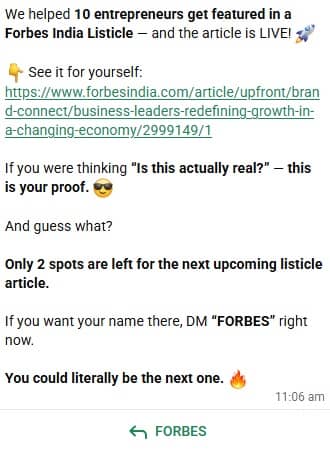
It then used three pressure tactics:
- Scarcity: “Only 2 spots left”
- Proof-by-link: “See it for yourself”
- Preemptive objection handling: “If you were thinking ‘Is this actually real?’, this is your proof”
The price quoted to the client was ₹25,000. The client asked for our opinion before paying. This is a normal part of our SEO retainer, but it’s also where an agency earns its fee.
What we checked, and what we found
Is this editorial content or advertising?
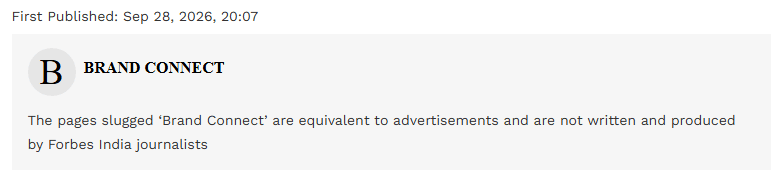
The URL path contained /upfront/brand-connect/. At the bottom of the page, Forbes India states that pages slugged “Brand Connect” are equivalent to advertisements and are not written or produced by its journalists. So the vendor’s proof of a “feature” was in fact proof of a paid placement.
Being on a listicle of 10 brands also means any authority is shared across ten entries, so you are not the focus of the page.
What does the link attribute say?
We inspected the page source (right-click → View Source, search for the client-style outbound link). The vendor had described the link as “dofollow.” There was no plain nofollow, but the link carried rel=”sponsored”.

Google introduced sponsored in 2019 to mark paid placements. Since March 2020, Google treats nofollow, sponsored and ugc as hints rather than strict commands. In practice, Google says paid links shouldn’t pass ranking credit, and we plan on that basis. A link that is labelled as paid, on a page labelled as an ad, is about the weakest possible ranking signal.
What would the client have gotten instead?
We’re not claiming such a link is worthless in every sense. A Brand Connect placement can give:
- Referral clicks from people reading that page
- A mention on a high-traffic domain, which may help with brand searches
- A credential to cite in conversations
But the client’s retainer goal was organic rankings and inbound search traffic, and on that metric the link would contribute close to nothing.
The “As Seen in Forbes” badge
The client’s real motivation was putting a Forbes badge on their landing page and sales deck. We flagged two problems:
- Trademark: Using Forbes’ name or logo as a credential generally needs permission. Check the placement terms in writing, and ask a lawyer.
- Misleading claims: Presenting a paid advertorial as independent press can be seen as deceptive, and ASCI and consumer-protection rules in India take misleading advertising seriously. It can also hurt trust if a prospect clicks through and sees the “advertisement” disclaimer.
Our recommendation
We told the client: if the goal is purely a vanity credential and you accept it’s an ad, that’s a legitimate business choice. But if the goal is SEO, this spend wouldn’t move rankings, and the badge use was risky. They passed, and we moved the budget to building outreach based guest post links from relevant websites.
A checklist for vetting any “premium publication” link pitch
Use this before paying for any placement:
- Check the URL path for terms like brand-connect, sponsored, partner-content, promoted, advertorial, brand-studio.
- Read the page footer and byline. Is there a disclaimer? Is the author a staff journalist?
- View the source and look at the rel attribute on the outbound link.
- Ask the vendor in writing: Is this editorial or paid? Will the link stay live, and for how long? Can I use the publication’s logo, and is that in the contract?
- Treat urgency as a red flag. “Only 2 spots left” and “DM now” are sales tactics. Genuine editorial coverage isn’t sold in slots.
- Match the purchase to the goal. Brand credibility, referral traffic and ranking power are three different outcomes, and one placement rarely delivers all three.
- Check whether you can earn it instead. Journalists respond to original data, expert commentary and newsworthy angles, which cost time rather than a flat fee.
The takeaway
A big domain name doesn’t make a link valuable. Run link-building and PR pitches past your SEO team before you pay, and check the URL, the disclaimer and the link attribute first. It takes about ten minutes.